| |
Ingham Spring is one of the largest springs in southeast Pennsylvania and forms the headwaters of Aquetong Creek in Solebury Township.The firm conducted a study to assess the groundwater contribution area to Ingham Spring and seasonal range of spring flow rates. This study was an essential step in the Township’s plan to develop and implement policies and practices to protect the quantity and quality of water issuing from this spring.
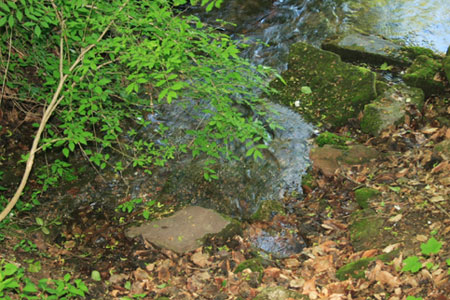
Ingham Spring Outlet Solebury Township, Pennsylvania.
The principal elements of the Ingham Spring evaluation included:
- Delineation of the surface-water drainage basins/watersheds
within the project area and evaluation of the geologic
framework and major geologic structural features.
- A field-based evaluation of groundwater flow conditions
involving the collection of water levels in over 200 wells,
and the development of a water-level contour map (potentiometric
surface map) for the project area.
- Delineation of groundwater divides and determination
of the groundwater contribution area to Ingham Spring on
the basis of the field-collected water level data and potentiometric
surface map interpretation.
- Evaluation of groundwater recharge for years of normal
and below-normal (drought) precipitation within the contribution
area to Ingham Spring, and a comparison of the spring discharge
measurements, particularly during the summer and fall months,
to the calculated groundwater recharge for the Ingham Spring
contribution area.
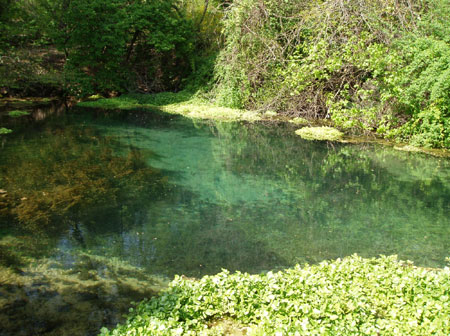
Ingham Spring Pond, Solebury Township, Pennsylvania.
BACK TO TOP |
| |
Bohol Province, in the central part of the Philippines, is blessed with numerous springs that issue from carbonate, volcanic and crystalline rock aquifer systems. There are over 2,000 documented springs in the province or about 1 spring for every 2 square kilometers. These springs are vital to the livelihood of the province and serve to supply drinking water to many of its residents, irrigate many hectares of cropland, provide important baseflow to all of the river systems in the province, and comprise an important future water resource for the province. The province is home to many large capacity springs some of which were developed for drinking water over 100 years ago (Bilibili Spring in Cortes Municipality). The springs serve many purposes in the province. Some are utilized for drinking water supply and also as a gathering spot for doing laundry and sharing stories (Kansaon Spring in Maribojoc Municipality). Others are utilized for the irrigation of rice paddy and other crops.
The firm conducted a project to assess the feasibility of utilizing groundwater as a sustainable source of public water supply for ten municipalities in the Province for the Bohol Water Company. The ten municipalities that were assessed are located within 25 km of the capital city of Tagbilaran, and in 2000, their population was about 182,000. Our principal assignment was to:
- Inventory current sources of water supply (wells and springs) in the ten municipalities and develop recommendations for future usage.
- Evaluate the sustainability of the underlying aquifer systems for long-term supply until the year 2020, and identify potential development constraints.
- Develop recommendations for a Phase 2 groundwater exploration program.
- Outline preliminary development costs to meet the projected year 2010 water demand.
Our study and analysis showed that on the mainland island of Bohol, there is an abundance of developable groundwater from either wells or springs to meet present and long-term future demands. On Panglao Island, where growth is projected to increase substantially, the groundwater resource is more limited and development should be carefully planned and executed.
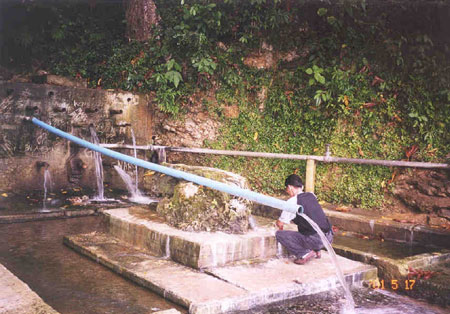
Bilibili Spring, Cortes Municipality, Bohol Province, Philippines.
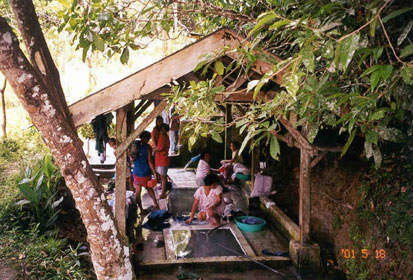
Kansaon Spring, Maribojoc Municipality, Bohol Province, Philippines.
BACK TO TOP |
| |
Vincent Uhl mentored engineering students from the
University of Pennsylvania during
the assessment-phase evaluations of potential sources
for village water supply systems in two locations in Cameroon.
These included the villages of Kop and Gundum in the Northwest
Province of Cameroon where several springs were evaluated. Springs were identified, their flows measured, and water quality samples were collected and analyzed. Four springs were
ultimately developed
as the main sources for permanent piped water supply systems.
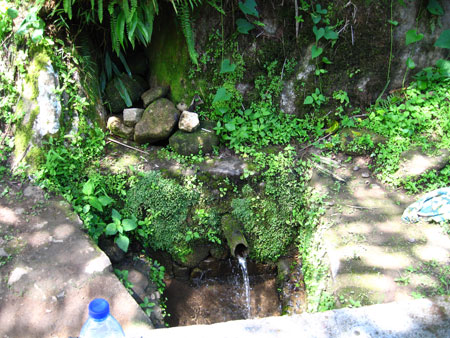
Spring Issuing from Granitic Bedrock in Kop Village, Northwest Cameroon.
BACK TO TOP |

 Vince Uhl: +1 (609) 947-1703